


In the high-stakes theater of AI copyright litigation—most notably NYT v. OpenAI and the GitHub Copilot cases—the public discourse remains fixated on the “Fair Use” defense. However, for senior counsel and risk officers, a far more clinical threat is emerging: Section 1202 of the DMCA. While Fair Use is a subjective, fact-specific battleground that can drag on for years, a Section 1202 claim targets a mechanical, structural violation: the systematic removal of Copyright Management Information (CMI).
In the AI supply chain, stripping the metadata doesn’t just clean the data; it erases the model’s right to exist.
The IPTech
The “Scrubbing” Problem: Beyond Mere Infringement
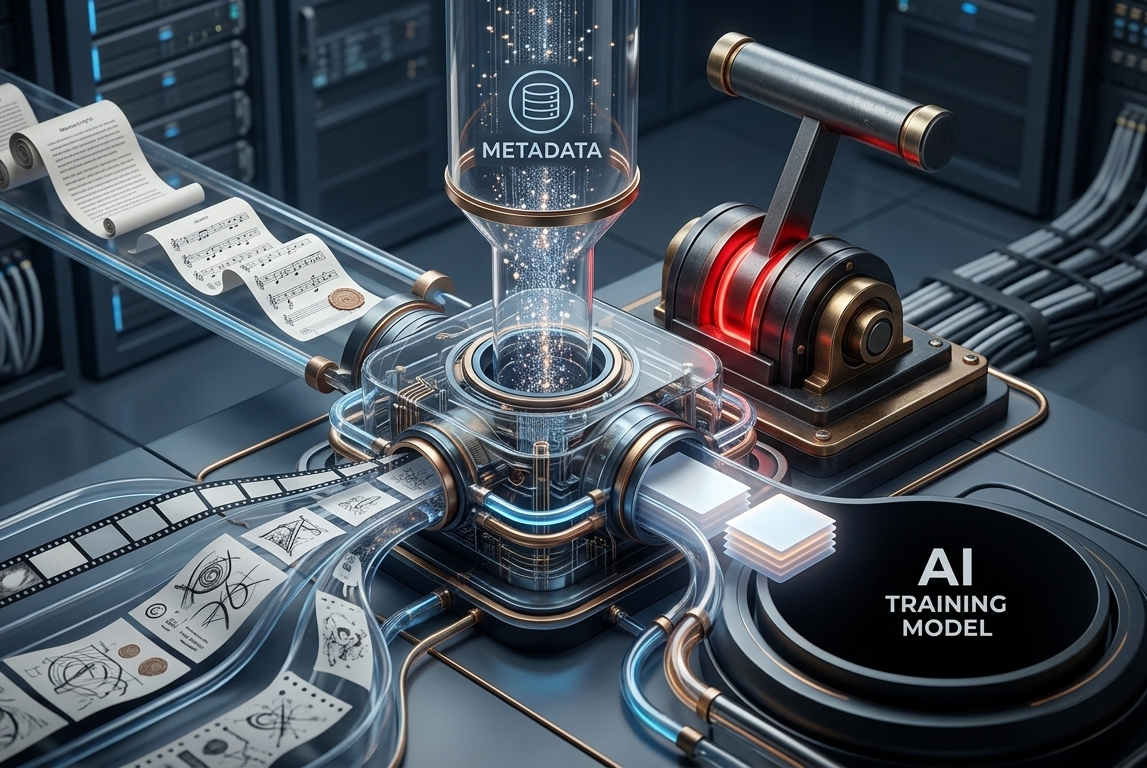
Section 1202 protects the “digital DNA” of a work. CMI includes author bylines, titles, copyright notices, and specific terms of use. During the pre-processing stage of Large Language Model (LLM) training, these metadata points are frequently “scrubbed” to create a clean, high-signal dataset for tokenization.
The legal crisis here isn’t just about whether the model copies the text; it’s about whether the model deliberately severs the link between the creator and the content. From a technical standpoint, this scrubbing is often performed to prevent the model from “overfitting” on headers and footers. From a legal standpoint, it looks like a deliberate attempt to anonymize stolen goods.

Why Section 1202 is a “Boardroom Nightmare”
The Good Faith Barrier: Fair Use arguments rely heavily on proving a “transformative” and “good faith” intent. However, systematically stripping author credits is often interpreted by courts as evidence of bad faith. It is notoriously difficult to argue that your use of a dataset is “fair” when the ingestion engine was specifically architected to ignore the names of the people who created that data.
The Scienter (Intent) Threshold: The battleground centers on Section 1202(b). Plaintiffs argue that AI developers removed CMI knowingly, understanding that doing so would conceal infringement. If a court finds that a data pipeline was designed to ignore CMI as a matter of engineering policy, the “automated process” defense begins to look like a deliberate omission.
The Statutory Damages Trap: Proving actual damages (lost revenue) in an AI context is a complex evidentiary hurdle that often requires expensive expert testimony. Section 1202 bypasses this by allowing for statutory damages of $2,500 to $25,000 per violation. When multiplied by millions of individual works in a training corpus, the potential liability is not just significant—it is existential. It creates a “solvency risk” that could theoretically bankrupt even the largest tech firms before a single “copying” claim is even decided.

Operational Strategy: The Move Toward “Attribution-Aware” Systems
The competitive advantage in 2026 has shifted. It is no longer about who has the largest dataset, but who has the most legally sustainable supply chain. A model built on “scrubbed” data is an asset with a hidden expiration date.
For leadership, the priority must move toward Attribution-Aware architectures. If your ingestion pipeline does not preserve the “Chain of Title” (the CMI) of your training data, you aren’t building a product; you are accumulating massive, unhedged legal debt.any design projects, but for web apps that demand repeated comfortable use, tension is not a desirable trait.
The CEO Checklist for 2026:
Audit the Pipeline: Does your data ingestion process automatically strip metadata? If so, is there a documented technical justification?
Contractual Indemnity: Ensure that AI vendor contracts specifically mention Section 1202. General “copyright” indemnity may not be enough to cover the massive statutory penalties associated with CMI removal.
Provenance Purity: Shift focus from “Big Data” to “Clean Data.” The most valuable models are those that can prove exactly where every token came from and that the author’s identity was respected throughout the training lifecycle.
Disclaimer: This analysis is provided for general informational and strategic purposes only and does not constitute professional advice, legal opinion, or a binding statement. Due to the dynamic nature of the subjects discussed, technical errors, inaccuracies, or omissions may occur, and information may become outdated over time. No warranty is provided regarding the accuracy or completeness of this content, and it is entirely non-binding. For specific implementation or compliance requirements, please consult with qualified professional advisors or legal counsel.